
Our system has noticed that you are based in , but the current country setting is . Select country

Tutorial: processing silicone
What do you need to pay attention to when processing silicone rubber compounds? What mistakes do people typically make? How do you avoid them? Our videos will provide you with a wealth of application tips for RTV silicone, 1-part silicone, 2-part silicone and silicone for potting electronics and electrical components. The focus is on industrial applications.
Processing silicone:
- Skin formation, potlife
- Potting electronics and electrical components
- Processing silicone resin
- Silicone primer
Skin-forming time, 1-part silicone
This video shows you how to test a silicone to determine whether it can still be processed.
Silicone cures from the outside in. Why is that? What does that mean for processing silicone?
Skin formation in a 1-part silicone:

This video shows ELASTOSIL® N9111, a universal silicone sealant and adhesive for household appliances and for the automotive and electronics industries. Click here for details and for downloading the technical data sheet.
2-part silicone: how to mix silicone
This video shows you how to select the right mixer for 2-part silicones.
The right way to process silicone: obtaining a good result for a 2-part silicone begins with mixing.
Optimizing the silicone mixing process:
Potlife of a 2-part silicone
This video demonstrates the differences in potlife for 2-part silicones.
How much time do I have for processing a 2-part silicone? Here you’ll find background information on industrial silicone processing.
Silicone potlife:
We’ll be happy to advise you on the perfect potlife for your application and process.

This video shows ELASTOSIL® RT 607, a 2-part silicone that remains flowable for a long time. When cured, it is flame retardant, highly resistant to heat and meets the requirements of EN 45545-1:2020 (“Fire protection on railway vehicles”) for hazard levels HL1, HL2 and HL3 with respect to requirements R22, R23 and R24.

This video shows ELASTOSIL® RT 772, a 2-part silicone that cures quickly at room temperature. This compound is flowable and ideal for potting in small appliances, white goods and mechanical engineering.
Potting material for electronics: deaerating the silicone
This video shows how to mix and deaerate a 2-part silicone for potting electronics and electrical components.
Why is it so important to deaerate silicones when potting electronics and electrical components? How is it done? Why should you work under a vacuum?
2-part silicone potting compound for electronics and electrical components:
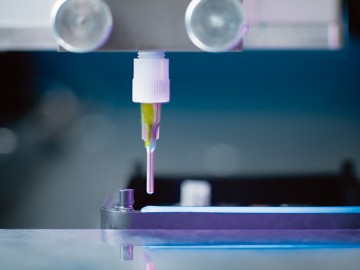
Electronics and electrical components
Room-temperature vulcanizing silicone elastomers from WACKER reliably protect against external influences, which ensures the functional safety of electrical and electronic components. As one of the world’s leading silicone manufacturers with many years of experience, WACKER is a competent partner of the industry and offers tailor-made solutions for potting, bonding, sealing and coating.
Potting electronics: heat-resistant potting
This video shows you how to use heat-resistant 2-part silicones to achieve void-free potting.
Exceptional heat resistance is often important for potting electrical and electronic components. Which silicones are right for the job?
2-part silicone potting compound, heat-resistant

This video shows ELASTOSIL® RT 607, a 2-part silicone that remains flowable for a long time. When cured, it is flame retardant, highly resistant to heat and meets the requirements of EN 45545-1:2020 (“Fire protection on railway vehicles”) for hazard levels HL1, HL2 and HL3 with respect to requirements R22, R23 and R24.
Adhesive failure: inhibition and silicones
This video explains factors that can disrupt crosslinking in a platinum-catalyzed silicone.
Does your silicone cure on the surface, yet fail to adhere to the substrate? Inhibition may be the reason.
Inhibition with platinum-catalyzed silicones:
Processing:
You can process addition-curing and condensation-curing silicones in the same production process as long as you are careful to choose the right silicone. We would be happy to advise you.
Adhesive failure: use a silicone primer
This video shows a test for determining whether you need a primer to improve the adhesion strength of a silicone.
What surfaces fail to bond with silicone? Does silicone adhere to acrylate? Do you need a primer? Testing the tensile lap-shear strength of an adhesive bond provides clarity for industrial applications.
Determining silicone adhesion strength:
We recommend testing adhesion strength systematically. We would be happy to advise you.
Silicone resins: processing information
This video shows how silicone resins cure and why it makes sense to use a curing catalyst.
Silicone resins may be solid or liquid depending on their degree of polymerization and molecular weight. One factor always holds true: silicone resins do not develop their full potential until they have been cured at elevated temperatures.
Using a curing catalyst:

SILRES®silicone resins are suitable for many different applications, ranging from composite materials to insulation for electrical coil windings. They are available as powders, flakes or liquids.
Thermal stability of silicone fluids
This video sheds light on the importance and efficacy of heat stabilizers in silicone fluids.
What is the benefit of silicone fluids containing heat stabilizers over standard silicone fluids? Learn more about the importance and efficacy of heat stabilizers.
Silicone fluids with heat stabilizers retain their functionality longer:

WACKER silicone fluids offer a perfect combination of ideal damping properties, long service life and reliability. That makes them an integral part of modern mechanical engineering, especially in high-capacity, top-performing combustion engines. Their superior functionality is particularly evident in applications that span a wide temperature range.
Two-part silicone: platinum-catalyzed crosslinking
This animation illustrates the crosslinking reaction of a platinum-catalyzed 2-part silicone.
How does silicone crosslink? Let's take a deep dive into the chemistry!
Crosslinking in platinum-catalyzed silicones:
Platinum-catalyzed curing is not the only crosslinking mechanism for silicones: condensation curing, which releases compounds such as acetic acid, amines or alcohols, is applicable here as well.

Moldmaking with silicones: quick guides for better results
Welcome to the moldmaking laboratory! Our experts have recorded short videos that address typical questions. These quick guides are just a few minutes long and show how you can easily achieve even better results when using ELASTOSIL®M.

Silicones from WACKER are key players in the most astonishing success stories – and yet they often remain behind the scenes. They get us from point A to point B on time, make housework easier and have even made the energy transition possible. They do hard work on the ocean floor – and sometimes they even go to outer space.

Whenever operational safety is at stake for sensitive parts or electrical components, silicones always provide reliable protection from external influences, such as heat, vibrations and moisture. Silicones keep their components working properly, from individual components to highly complex traction motors for rail vehicles – even under extreme conditions. Come see us each year at the CWIEME tradeshow.
Related: