
Our system has noticed that you are based in , but the current country setting is . Select country

Every drop counts
Everyone realizes just how important water is, especially during hot, dry periods. The chemical industry uses it in many different ways, whether as cooling water, steam, or for cleaning. We have adopted a broad-based strategy aimed at ensuring sustainable water management at all of our sites around the world. Two projects at our Nünchritz site demonstrate how this works in practice.
The Nünchritz plant is a highly integrated production system. Materials, energy, and resources are used as efficiently as possible and recycled. As is the case with water. It is essential for countless processes. Our philosophy regarding water consumption is to use as little as possible and recycle it as often as possible. Environmental departments and utilities at all WACKER sites are constantly working to achieve this.
Water is already being used very efficiently at the Nünchritz site: each cubic meter is reused an average of 28 times. About nine out of every ten liters are returned to the site's recycling loop after use.
New pipes close off circulating loops

WACKER's Nünchritz site has adopted closed-loop water circuits, thereby significantly reducing its withdrawal of well water.
Innovative ideas for better water management are therefore welcome and are encouraged at WACKER. For example, by recycling water that has already been used, thereby reducing the amount of well water consumed. A number of such measures have been implemented at the Nünchritz site in recent years. One of these was the use of cooling water from the methyl chloride plant, a key step in the production of silicones. Today, this water is piped through a newly installed line to a water treatment plant at the facility, where it is used as a substitute for fresh water. This allows for approximately 25 cubic meters of water to be reused per hour, rather than drawing additional fresh well water.
The endeavor was supplemented by an additional measure: so-called desalinated water now replaces fresh water in a chemically necessary scrubber. “Desalination” refers to the process of draining off part of the water from a cooling water circuit. This is necessary, as otherwise the dissolved salts in the cooling water would evaporate and become more concentrated, which would lead to corrosion. A new pipeline and a control and filtration station were installed to enable the reuse of the desalinated water.

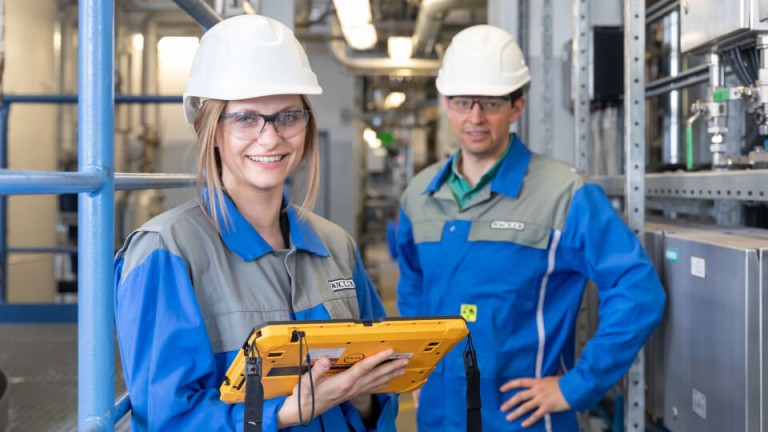
Working together for greater water efficiency: employees at the Nünchritz site are driving projects for sustainable water use.
The success is quantifiable. Together, these two measures have reduced the site’s well water withdrawal by more than ten percent. At the same time, resource efficiency has increased because existing water flows are reused multiple times.
Steam, i.e., water in gaseous form, also drives many processes in chemicals manufacturing. Cooling water can be recycled for this, too. This has the added benefit of being a few degrees warmer than fresh water. This means that less energy is needed for evaporation at 100°C. Our colleagues implemented this measure last year.
These projects are making a direct contribution to WACKER’s groupwide water stewardship strategy. They demonstrate how the intelligent use of the water cycle can reduce water consumption and further enhance sustainable production.
The Group's goal

Climate change is altering local water resources. This is why WACKER is adapting its water management practices to the specific conditions in each region.
WACKER ensures sustainable water stewardship at 100 percent of its global production sites (annual target). Our Group target is a voluntary one that goes beyond the legal requirements at individual sites. The target includes all production sites, water and marine resources, and water risk zones.
Each production site is required to maintain an up-to-date “WACKER Water Stewardship” assessment. The new groupwide water target was presented in the latest annual report. We will publish results on target achievement for the first time for the 2026 reporting year.

Overview of WACKER’s water balance at the Nünchritz site in 2025 (1) including fire department drills 3,000 m³ (2) treated wastewater (effluent from treatment plants)

Constituent elements of our “WACKER Water Stewardship” program in accordance with the United Nations’ Sustainable Development Goal 6 (SDG 6) and international standards:
Learn more about our groupwide water management aligned with international standards at: