

Our system has noticed that you are based in , but the current country setting is . Select country
WACKER anticipates slight growth in 2026
With the presentation of its 2025 Annual Report today, Wacker Chemie AG confirmed that its sales and earnings in 2025 fell versus the previous year due to a challenging market environment.
The Group’s total sales came to €5.49 billion, 4 percent less than in 2024 (€5.72 billion). The reported Group EBITDA (earnings before interest, taxes, depreciation and amortization) totaled €427 million (2024: €744 million), down 43 percent. This was due not only to lower volumes and prices, but also to lower plant-utilization rates and the persistently high energy costs in Germany.
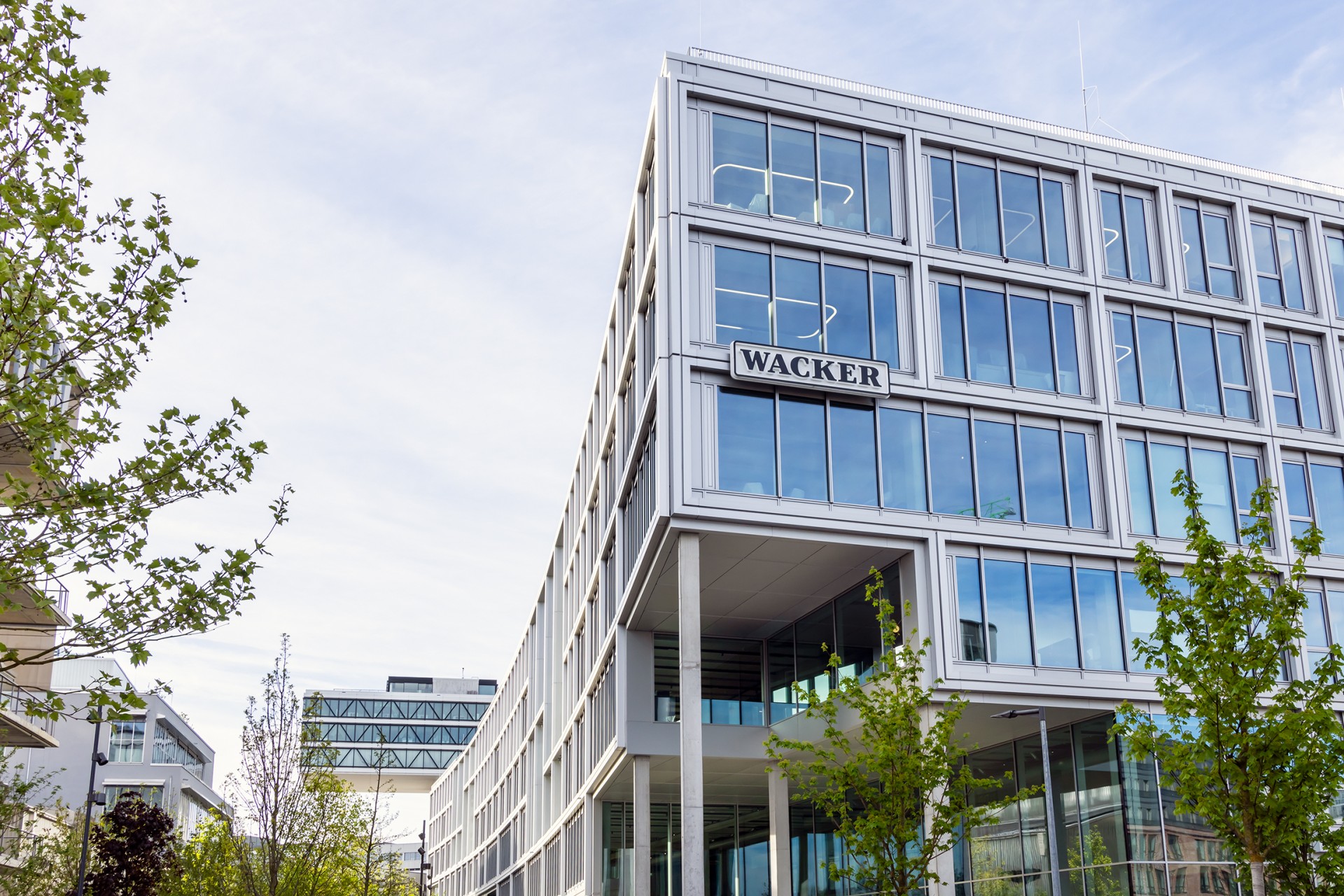
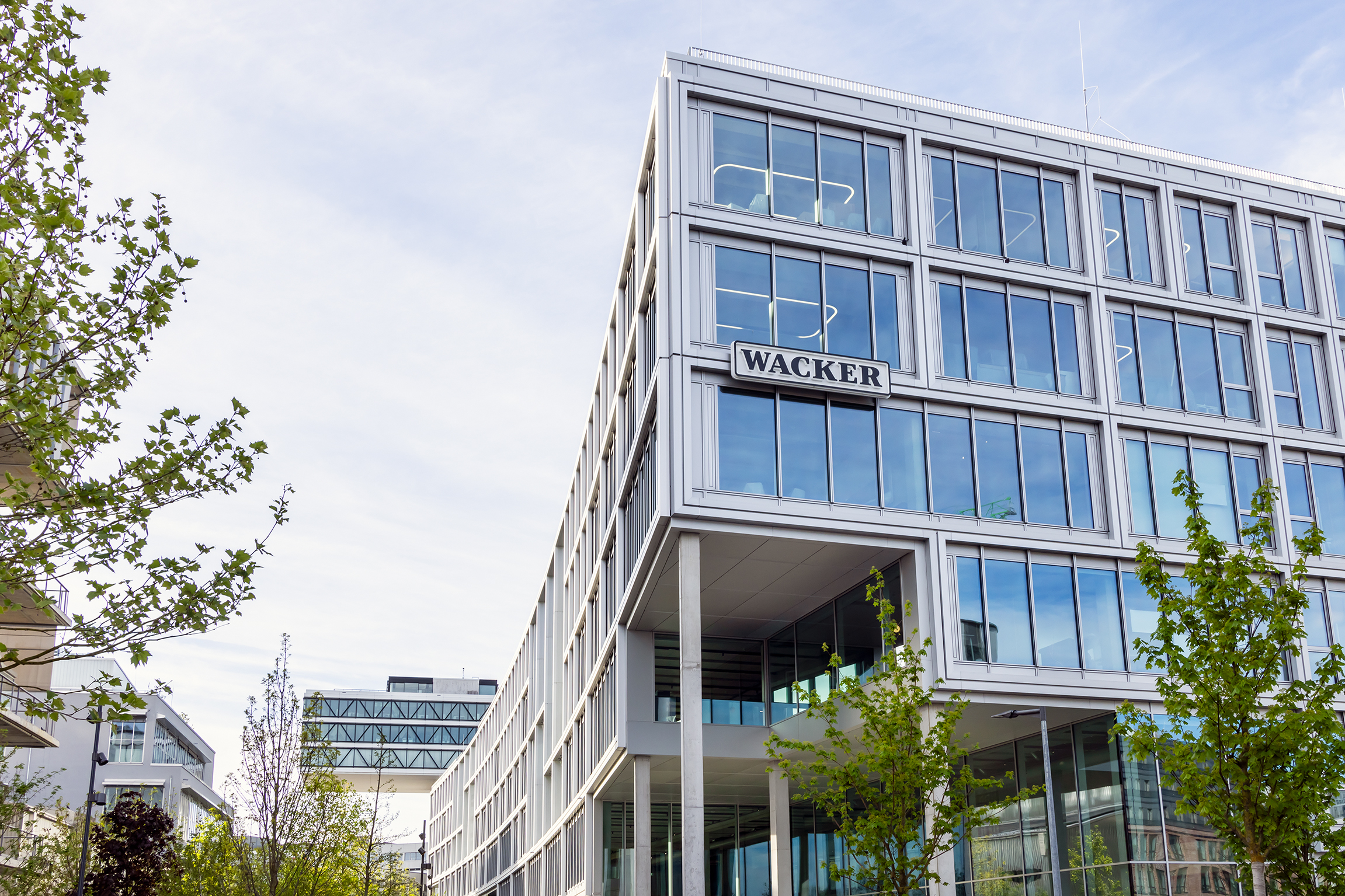
Wacker Chemie AG’s headquarters, WACKER House, are located in Munich’s Werksviertel district. (source: Wacker Chemie AG)
In addition, earnings were negatively impacted by special effects for restructuring amounting to €103 million as part of the ongoing PACE cost-saving project. EBITDA (excluding special effects) consequently amounted to €529 million, 29 percent below the prior-year figure.
In 2025, sales and EBITDA (excluding special effects) were therefore in line with current consensus expectations, which put WACKER’s average Group sales at €5.48 billion and its EBITDA at an average of €523 million (source: Vara Research, February 11, 2026).
Due to the effects described above, earnings before interest and taxes (EBIT) were negative, amounting to €-180 million in 2025 (2024: €271 million). Depreciation and amortization amounted to €606 million, up considerably on the previous year (€473 million). This can be explained, among other factors, by an impairment of goodwill associated with the acquisition of ADL Biopharma in Spain.
The net result for 2025 was in negative territory at €-805 million (2024: €261 million) due to special effects and valuation adjustments. In total, the valuation adjustments that took effect at the end of 2025 came to approximately €600 million. Of this amount, €308 million is attributable to an adjustment relating to the shares in Siltronic AG, whose share price was consistently below the carrying amount. €194 million relates to deferred tax assets in Germany, which are no longer recoverable. €89 million is associated with the impairment of goodwill in Spain referred to above.
As a result of the net loss for the year, the Executive and Supervisory Boards will be proposing to the Annual Shareholders’ Meeting on May 6, 2026, that no dividend be distributed for 2025.
“In 2025, the chemical industry faced tremendous pressure. Demand in many customer sectors remained weak. Trade conflicts and geopolitical crises triggered uncertainty on the market, making customers reluctant to place orders. Many companies postponed investment spending,” explained WACKER CEO Christian Hartel at the Annual Press Conference held on Wednesday in Munich. “In addition, new competitors are entering the market,” he continued, pointing to what are now high levels of excess capacity in many areas and fundamental shifts in the market.
In this challenging environment, WACKER, like many other chemical companies, had to adjust its original 2025 targets downwards in the course of the year. “With annual sales of €5.49 billion and EBITDA of around €529 million before special effects, we are in line with market expectations. But we cannot be satisfied with that,” added Hartel.
In order to strengthen WACKER’s competitiveness, the company launched “PACE,” the largest cost-saving project in its history, in October 2025. PACE is aimed at reducing production-related and administrative costs by more than €300 million a year. “This will bring our costs to a competitive level and put WACKER back on track for success,” emphasized Hartel. In order to meet this target, more than 1,500 jobs will be reduced worldwide, most of them in Germany. This is something WACKER had already announced in 2025. The question as to when the company can release details on job reductions in Germany will depend on the progress of the ongoing negotiations with the employee representatives.
The company expects sales of approximately €1.35 billion for the first quarter, lower than Q1 2025. This decline is largely attributable to negative currency effects. But EBITDA is likely to range between €140 and €160 million, higher than the prior-year level. Here, the cost savings have a positive impact. Looking at the year as a whole, WACKER predicts low single-digit percentage growth in sales and EBITDA to range between €550 million and €700 million. Potential impact from the current developments in the Middle East are not included in the forecast.
“We still do not see any signs of a turnaround on the market. This makes the levers that we can pull ourselves all the more important. We will continue to work hard on them in 2026," said Hartel. He added that WACKER would make a return to profitable growth in the medium and long term. “PACE will make us competitive again. At the same time, we elevate our business model and value proposition. In our chemical divisions, we are focusing on specialties; in the Polysilicon division, we are concentrating on the semiconductor market. In our life sciences division, Biosolutions, the focus is on biotech solutions. This strategy puts us in a good position to best serve our customers going forward,” he stated.
In 2025, WACKER generated around 83 percent of its sales outside Germany and 17 percent in Germany. The trend in Asia and the Americas was negative, but stable in Europe. Sales in Asia totaled €1.92 billion (2024: €2.11 billion), down by 9 percent. WACKER generated sales of €2.22 billion in Europe (2024: €2.21 billion). In the Americas, sales decreased 5 percent to €1.02 billion (2024: €1.07 billion).
Capital expenditures totaled €466 million in 2025, a year-over-year decline of 34 percent (2024: €709 million). Investing activities worldwide covered all four divisions. In the chemical divisions, funds were invested among other things in a new production plant in Karlovy Vary, Czech Republic, that will produce room-temperature-curing high-performance silicones from 2026 onwards. Capacities for the production of specialty silicones were also expanded in Zhangjiagang, China, at the Japanese site in Tsukuba and in Jincheon in South Korea. WACKER also invested in capacity expansion for VAE dispersions at Calvert City, USA. WACKER increased its capacity to produce semiconductor-grade polysilicon at its Burghausen site in Germany. The new cleaning line has enabled WACKER to increase capacities for hyperpure semiconductor-grade polysilicon by more than 50 percent and to further enhance purity levels. In the Biosolutions division, funds were invested in a new research center for innovative biotech solutions. The WACKER Biotechnology Center opened in Munich in the middle of the year.
The number of employees declined by 170 in 2025. As at December 31, 2025, WACKER had 16,467 employees worldwide (December 31, 2024: 16,637 employees). As of the reporting date, this included 10,749 employees at its sites in Germany (2024: 10,657) and 5,718 at its sites elsewhere (2024: 5,980).
Net cash flow, net financial debt and equity ratio
Net cash flow in 2025 was almost balanced at €-4 million (2024: €-326 million). The main reason for the year-over-year improvement was a significant reduction in inventories and lower cash flow from investing activities.
As of December 31, 2025, WACKER reported net financial debt of €886 million (December 31, 2024: €691 million).
The Group’s total assets amounted to €8.37 billion as of December 31, 2025 (December 31, 2024: €9.41 billion), down 11 percent. Fixed assets were down year over year due to impairment losses and reduced investment spending. Inventories were also substantially lower, mainly as a result of a targeted inventory-reduction program. In the fourth quarter of 2025, WACKER successfully issued a promissory note (German Schuldschein) in the amount of €435 million, maturing in 2028, 2030 and 2032. As of December 31, 2025, WACKER posted liquid assets of €1.48 billion (December 31, 2024: €1.21 billion).
Equity decreased 22 percent year over year, and reached €3.76 billion at the reporting date (December 31, 2024: €4.84 billion). The equity ratio of 44.9 percent was lower than in the previous year (2024: 51.4 percent).
Silicones reported a slight decline in sales and EBITDA in 2025. Sales came to €2.73 billion, down by around 3 percent year over year (2024: €2.81 billion). EBITDA came in at €336 million, almost on par with the previous year (2024: €341 million). EBITDA was impacted by negative volume/mix and currency effects as well as by low plant-utilization rates.
Sales and EBITDA declined in Polymers in 2025. Sales decreased 6 percent to €1.38 billion (2024: €1.46 billion). In particular, the weak construction industry – especially in China and western Europe – had a negative impact on business. EBITDA was down 19 percent year over year to €158 million (2024: €194 million) due to lower sales as a result of lower volumes, negative currency effects and lower selling prices, coupled with higher costs.
Biosolutions declined short of the prior-year figures for both sales and EBITDA in 2025. Sales fell by 4 percent in 2025 to total €360 million (2024: €375 million). At €21 million, EBITDA was substantially lower year over year (2024: €35 million) due to lower volumes of established products, a reduction in customer offtake and exchange-rate effects.
Both sales and EBITDA declined in Polysilicon. Sales decreased 7 percent to €883 million (2024: €949 million). EBITDA contracted by 50 percent to €96 million (2024: €193 million), primarily prompted by lower solar-grade polysilicon volumes sold. Low capacity-utilization rates had a negative impact. By contrast, the business with hyperpure semiconductor-grade polysilicon performed very well.
WACKER anticipates overall flat selling prices and rising volumes in 2026. The Group expects foreign exchange rates to have a negative effect on sales. Altogether, WACKER expects sales to grow in a low single-digit percentage range (sales in 2025: €5.49 billion). EBITDA is expected to range between €550 million and €700 million in 2026, with the EBITDA margin predicted to be in the low double digits. Investments are predicted to total about €300 million in 2026.
The company expects net financial debt to be down on the prior-year figure by a low double-digit percentage. WACKER predicts positive net cash flow in 2026 at a level well above 2025.
At Silicones, WACKER is forecasting sales on par with the previous year in 2026. Higher volumes and selling prices are likely to be offset by negative currency effects. The EBITDA margin is expected to improve slightly over the prior-year level.
Sales in the Polymers division are also expected to be on a par with the previous year. Here, too, higher volumes and, in some cases, higher selling prices will be offset by negative currency effects. The EBITDA margin should be slightly above the prior-year level.
In Biosolutions, the company expects sales to grow in a high single-digit percentage range in a market environment that will remain challenging. EBITDA is likely to be around €30 million.
Sales at Polysilicon are expected to rise, with growth likely to be in the low double-digit percentage range. The company expects volumes of semiconductor-grade polysilicon to increase substantially, while the solar-grade polysilicon business will remain challenging. EBITDA is likely to match 2025’s level. The higher sales, together with efficiency measures, are likely to be offset by higher energy costs. This forecast does not include any significant effects from possible trade-policy measures.
Key figures for the WACKER Group for 2025
| € million | December 31, 2025 | December 31, 2024 | Change in % |
|---|---|---|---|
| Results / return | |||
| Sales | 5,485.3 | 5,721.8 | -4.1 |
| EBITDA1, 2 | 426.7 | 743.6 | -42.6 |
| EBITDA margin3 (%) | 7.8 | 13.0 | N/A |
| EBIT2, 4 | -179.7 | 270.9 | N/A |
| EBIT margin3 (%) | -3.3 | 4.7 | N/A |
| EBITDA/EBIT includes: restructuring expenses | -102.6 | – | N/A |
| Financial result2 | -398.6 | -12.5 | >100 |
| Income before income taxes | -578.3 | 258.4 | N/A |
| Net result for the year | -804.9 | 260.7 | N/A |
| Earnings per share (basic/diluted) (€) | -16.53 | 4.85 | N/A |
| ROCE (%) | -3.1 | 5.0 | N/A |
| Financial position/cash flow | |||
| Total assets | 8,371.0 | 9,409.9 | -11.0 |
| Equity | 3,755.6 | 4,837.0 | -22.4 |
| Equity ratio (%) | 44.9 | 51.4 | N/A |
| Liquidity5 | 1,482.9 | 1,256.1 | 18.1 |
| Financing liabilities | 2,368.6 | 1,946.7 | 21.7 |
| Net financial debt6 | -885.7 | -690.6 | 28.3 |
| Capital expenditures7, 8 | 465.9 | 709.4 | -34.3 |
| Depreciation/amortization | -606.4 | -472.7 | 28.3 |
| Net cash flow9 | -3.6 | -326.0 | -98.9 |
| Research and development | |||
| Research and development expenses | 214.6 | 203.7 | 5.4 |
| Employees | |||
| Personnel expenses | 1,560.8 | 1,579.8 | -1.2 |
| Employees (number as of December 31) | 16,467 | 16,637 | -1.0 |
1 EBITDA is EBIT before depreciation and amortization.
2 Investments in joint ventures and associates and other income reclassified to the financial result (€329.7 million in expenses; previous year: €19.2 million in income); EBITDA and EBIT adjusted accordingly. Details can be found under “Changes in accounting policies” in the 2025 Annual Report.
3 Margins are calculated based on sales.
4 EBIT is the result from continuing operations for the period before investments in associates, interest result and other financial result, and income taxes.
5 Securities, fixed-term deposits, cash and cash equivalents
6 Sum of cash and cash equivalents, noncurrent and current securities, and noncurrent and current financing liabilities.
7 Intangible assets, property, plant and equipment, investment property, excluding right-of-use assets.
8 Due to a change in accounting policy, carbon credits are reported under intangible assets, meaning that they are allocated to capital expenditures (amounting to €11.5 million; previous year: €43.4 million). They were previously reported under inventories. Details can be found under “Changes in accounting policies” in the 2025 Annual Report.
9 Sum of cash flow from operating activities and cash flow from long-term investing activities (before securities).
This press release contains forward-looking statements based on assumptions and estimates of WACKER’s Executive Board. Although we assume the expectations in these forward-looking statements are realistic, we cannot guarantee they will prove to be correct. The assumptions may harbor risks and uncertainties that may cause the actual figures to differ considerably from the forward-looking statements. Factors that may cause such discrepancies include changes in the economic and business environment, variations in exchange and interest rates, the introduction of competing products, lack of acceptance for new products or services, and changes in corporate strategy. WACKER does not plan to update the forward-looking statements, nor does it assume the obligation to do so.
Press Picture


Download
Documents
Press Information
view link