

Additives and admixtures for infrastructure and concrete

Additives and admixtures for sprayed concrete based on vinyl acetate-ethylene copolymers make particularly efficient processing and impermeability possible.
Infrastructure such as bridges, roads and tunnels are exposed to extreme mechanical loads. Weathering, chemical corrosion and moisture all weaken the structure of concrete. They also promote cracking and shorten its useful life. We address these challenges by providing a wide range of innovative solutions.
Specialty additives and admixtures selectively improve the properties of concrete and open up new applications: as additives (<5%) and admixtures (>5%), polymer binders increase adhesion and flexibility in cementitious systems such as repair mortars, while water-repellent agents afford concrete lasting protection against moisture – both as integral treatment and through post-application impregnation.
Concrete and infrastructure – challenges and solutions
Typical challenges:
Our solution:
Using ETONIS® as an additive or admixture can significantly improve the durability of concrete in demanding applications. In addition, polymer binders enhance adhesion, flexibility and strength in repair mortars. SILRES® BS and GENIOSIL® water-repellent agents reduce capillary water absorption in concrete, prevent efflorescence and extend the useful life.
This results in long-lasting concrete structures with less maintenance outlay – ideal for bridges, roads, tunnels, dams or any other structure that must meet the highest standards of safety and durability.
Water-repellent agents for non-load-bearing concrete structures and buildings
SILRES® BS silanes and specialty silane/siloxane emulsions are suitable for the integral water-repellent treatment of non-load-bearing concrete structures and concrete buildings. Our sealants considerably reduce water absorption, protect against efflorescence, among other things, and make concrete structures more durable as a result of enhanced water repellency.
Product properties
Silanes and silane/siloxane emulsions
Benefits:

Applications:
Polymer binders for soil stabilization
ETONIS® brand polymer binders, developed specifically for soil stabilization applications, are ideal for the effective, cost-efficient and extremely long-lasting stabilization of roads and parking areas.

Product properties:
Polymer binders
Benefits:
=> Increased durability and longevity of infrastructure
Applications:
Additives and admixtures for water stewardship and tunneling
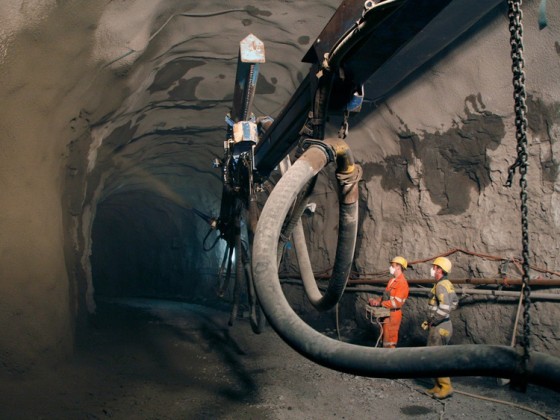
Additives and admixtures in the ETONIS® product family provide concrete with particularly good adhesion to various substrates, especially smooth surfaces such as metal and wet rock. Such modified concrete is ideal for water stewardship and tunneling and provides reliable protection against hydrostatic pressure as well.
Product properties
Polymer additives/admixtures
How concrete benefits:
Advantages of sprayed concrete:
Applications:
Wet and dry spraying onto smooth, wet substrates, during the construction or remediation of tunnels and sewers.
Dispersible polymer powders and additives/admixtures for protecting and restoring concrete
Vinyl acetate-ethylene (VAE) dispersible polymer powders enhance technical performance, as well as the processing and wetting properties of repair mortars.
ETONIS® brand additives and admixtures allow you to formulate concrete mixtures that can equally withstand considerable mechanical stress, frequent freeze-thaw cycles and chemical degradation.
Product properties
Advantages of dispersible polymer powders:
Applications of dispersible polymer powders:

Advantages of polymeric additives/admixtures:
Applications of polymeric additives/admixtures:
Hydrophobic agents and binders for infrastructural applications
Water-repellent impregnation based on SILRES® BS silanes and silane/siloxane emulsions reliably protects concrete structures from moisture and water-soluble salts. These low-VOC water-repellent agents preserve the value of buildings, extend their useful life and reduce maintenance costs and repairs resulting from structural damage. They comply with the current EN 1504-2 standard.
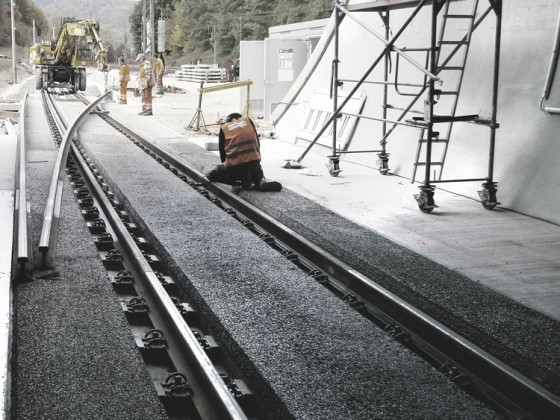
The ETONIS® product line offers products for road surfacing subjected to particularly high mechanical stress, such as pervious concrete. Pervious concrete modified with ETONIS® is notable for its excellent resistance to frost and road salts and offers reliable protection against aquaplaning, flooding and noise.
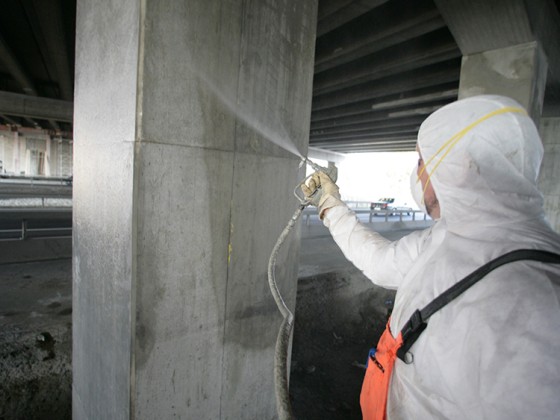
A pier of a German autobahn bridge being impregnated with SILRES® BS water-repellent agent.
Product properties
Advantages of silanes and silane/siloxane formulations:
Applications of silanes and silane/siloxane formulations:
Surface treatment of:
Advantages of concrete additives:
Application:
Road surfacing
Additives and admixtures for concrete structures
The ETONIS® family of additives and admixtures opens up new perspectives in (structural) concrete design. For example, facade elements can be reinforced with glass mat, polymer fibers or carbon fibers. ETONIS® products enhance the bond between the concrete and the fibers. Studies on polypropylene fibers have shown that the tensile strength of the composite material can be increased by up to 25% through the addition of ETONIS®.
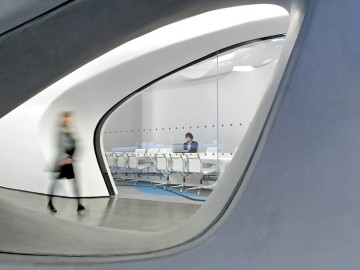
Self-filling concrete compound (SFCC) is possible, too. This is achieved by stirring water into the ETONIS®-modified dry-mix mortar directly on site and pouring it over the existing stone – an exceptionally strong concrete composite forms very quickly.
One especially promising approach is concrete modification for 3D printing. ETONIS® works here by optimizing the various properties needed for additive manufacturing (3D printing), such as thixotropy and setting time as well as the mechanical properties of the finished product.


Product properties
Polymer additives and admixtures
Benefits in fresh concrete:
Benefits in hardened concrete:
Applications:
FAQs on infrastructure and concrete
Why are additives/admixtures used in concrete?
When used as an admixture or additive, ETONIS® enhances the mechanical and processing properties of concrete. They increase adhesion, flexibility and durability, and open up new possibilities for (structural) design.
How do SILRES® BS and GENIOSIL® water-repellent agents protect concrete and infrastructure?
SILRES® BS and GENIOSIL® water-repellent agents prevent water and water-soluble salts from penetrating the concrete. This reliably prevents cracking, efflorescence and corrosion and extends the useful life of concrete structures.
What are the advantages of polymer binders in repair mortars?
Our dispersible polymer powders improve the adhesion and flexibility of mortars, increase their flexural strength and reduce cracking. This results in long-lasting repair layers, even in the event of high loads.
What kind of applications does the ETONIS® product family cover?
ETONIS® is used in a wide range of applications: from soil stabilization and tunneling through to concrete restoration and 3D printing. Our products optimize the rheological properties of concrete and increase its strength.
How do additives and admixtures contribute to sustainability in the construction sector?
By extending the useful life, reducing maintenance-related outlay and optimizing material use, additives and admixtures reduce the carbonfootprint of concrete structures and contribute to sustainable infrastructure development.
Additional information
SILRES® BS | Concrete Protection
DownloadSILRES® BS | Concrete Protection
DownloadETONIS® Polymer Binders | Optimizing Construction with Modified Concrete
DownloadSILRES® and GENIOSIL® | Architectural Coatings and Construction Materials
DownloadSILRES® BS | Organosilicones for Cement Hydrophobization | Reprint ZKG 9/2020
Download