
Our system has noticed that you are based in , but the current country setting is . Select country

Improving battery safety with silicones
Potting compounds
Thermal barriers
Coatings
Composite materials
Development of electric vehicles is moving at an astonishing pace, as the energy density of the batteries surges with each successive product generation. This underscores the critical need for a thermal barrier between the battery and the passenger compartment. WACKER silicones can deliver crucial improvements to battery safety and longevity.
The goal: safe, long-lasting EV batteries
These key challenges are the guiding forces behind WACKER’s silicones portfolio for battery safety:
Safe operation

Silicones...
Thermal runaway of a cell

Silicones...
Thermal propagation

Silicones...
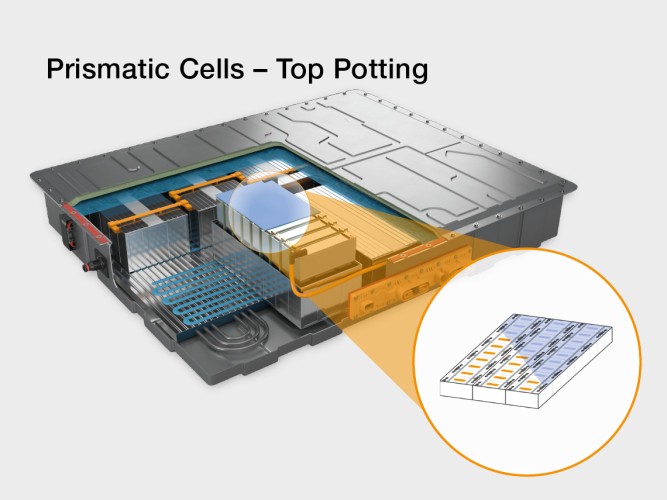
Potting compounds for battery cells and batteries
Silicones can prevent thermal runaway and protect adjacent components. This is achieved by potting battery components such as battery cells, cell contact system and battery vents.
Our technical service personnel will be happy to assist you.




Thermal barriers for insulating batteries

Flexible thermal barriers (heat shields and battery covers)
The ELASTOSIL® CM series has been specially developed for particularly thin, flexible thermal barriers. Materials treated with these silicone elastomers perform very well in thermal propagation tests.
Properties of ELASTOSIL® CM series
The result is a highly effective surface that provides mechanical stability.
Even more important, however, is the significantly improved heat resistance. In a thermal runaway, temperatures briefly far exceed 1,000 °C. Many carrier fabrics would melt under these conditions.
The ELASTOSIL® CM series prevents exactly that. The silicone elastomers ceramify at high temperatures to form a hard, thermally and electrically insulating layer. This ceramic layer protects the carrier material, keeps it functional and forms a stable barrier against heat and particles.

Rigid thermal barriers (heat shields and battery covers)
Silicone resins are highly flame and heat resistant, exhibit a low fire load, can interact with fillers and fibers and can form a protective ceramic layer. The functionality of a silicone-resin-based laminate remains intact, even in the event of a fire. Silicone-resin-based fiber-reinforced composites can be used in battery covers or heat shields, thus protecting the passenger compartment in the event of thermal runaway.
Properties of composite materials made with high-performance resins:

Heat-resistant coatings for battery covers
A thermally insulating battery cover enhances passenger compartment safety in the event of thermal runaway in a battery cell. And that is exactly what a ceramifying coating of ELASTOSIL® CM 145 (sprayable) does: it makes the battery cover more heat resistant.

ELASTOSIL® CM 145 can be applied to a woven fabric, to mica paper or to metal using a fully automated spraying system. Shown here is a standardized gas torch test.
Test parameters:
| No. | Time | Front-surface temperature | Rear-surface temperature |
|---|---|---|---|
| 1 | 200 s | 700 °C | 202 °C |
| 2 | 6 s | Particle bombardment | |
| 3 | 100 s | 1,200 °C | 298 °C |

The ELASTOSIL® CM 145 coating is still intact after being subjected to high temperatures for five minutes. The thickness of the coating grows from 1.44 mm to nearly 6 mm. Its electrical strength rises slightly. Volume and surface resistance remain virtually unchanged.
| ELASTOSIL® CM 145 | Before torch test | After torch test |
|---|---|---|
| Thickness [mm] | 1.44 | 5.92 |
| Dielectric strength [kV] | 18.1 | 10.1 |
| Volume resistance [Ohm] | 7.65E/+11 | 6.12E/+13 |
| Surface resistance [Ohm] | 5.28E/+13 | 5.19E/+10 |
ELASTOSIL® CM 145 is an innovative silicone coating for use in battery housings.
This product can provide significant protection for vehicle occupants in the event of thermal runaway.

Heat-resistant coating for busbars
Busbar coatings for optimum charging: ELASTOSIL® R 531/60 and ELASTOSIL® LR 3011/50. Extremely high voltages are used for charging batteries. That can cause adjacent components to overheat. The challenge in the winter, by contrast, is extreme cold. A coating of high-performance silicone elastomers optimizes resistance to heat and cold.
Properties of ELASTOSIL® R 531/60 and ELASTOSIL® LR 3011/50:
Other high-performance silicones for batteries
WACKER offers a wide range of specialty silicones for the following applications:
Download: Product guide on e-mobility
32 pages packed with high-performance silicones. Download our guide now!

WACKER silicones for e-mobility
How can we help move your project forward?

Dr. Martina Schüssler, Chemist & Battery Safety Expert
We are a leading silicones manufacturer with four excellence centers focused on e-mobility issues. Our global teams support OEMs and first-tier suppliers, from the initial concept to series production.
Drop us a line!
Our silicone highlights for batteries
Related: