

Our system has noticed that you are based in , but the current country setting is . Select country

Modern tile adhesives:
A formula for every need
Tiles have really been booming in recent years: the variety of tiles available for all manner of applications, installation techniques and demands is greater now than ever before. And tile adhesives modified with polymers like VINNAPAS® have been helping pave the way for this development.
Today’s tiles are installed on more than just screed: you’ll also find them on facades and on a variety of substrates, such as gypsum plasterboard, wood and even old tiles. And if they are to stand up to all of these challenges over the long term, polymer-modified tile adhesives are a must.

Read our article for an intro to polymer modification for tile adhesives: “ Modern tile adhesives: building materials with superpowers”
Already familiar with the basics of polymer modification for tile adhesives? Then keep reading: in this article, we’ll take a deep dive into a few special demands on tile adhesives. And learn why modern tile adhesives with VINNAPAS® are the formula for every (specialized) need.
The formula for the future of construction

No matter where you are in the world, the chances are pretty good that you’ll walk on tiles there – or encounter them on facades. Global consumption of tiles rose by 5.6% between 2020 and 2025 alone.

There are a lot of reasons for that: tiles can be used anywhere, they’re ideal for both hot and cold climates, they’re hygienic, easy to clean, water resistant and non-flammable – there’s also an incredible variety to choose from. And that’s not all: tiles can also play a big role in “making cities and human settlements inclusive, safe, resilient and sustainable” – in keeping with UN Goal No. 11 for Sustainable Development (SDG).
It’s a fact: buildings generate a large part of the world’s CO2 emissions. That means we’re going to have to change the way we build. How will that affect tiling? How sustainable is tile installation? How can we make it better? And what role do tile adhesives play in that?
Discover the reasons why polymer-modified tile adhesives are the formula for the future of construction.
The formula for modern materials
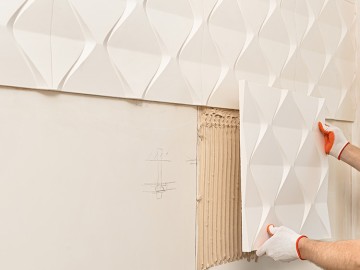
Today’s tiles are markedly different from those we installed 20 years ago. Their smooth surfaces and low water uptake influence adhesion – and the choice of tile adhesive.
Water absorption is 0.5% or less in the better part of the tiles used throughout the world today. That quickly exposes the limits of traditional tile adhesives made of cement, fillers and water, because they can’t penetrate the tiles’ pores. This is where modern chemistry comes to the rescue: polymer modification compensates for low water uptake and improves adhesion.
Discover what makes tile adhesives containing VINNAPAS® dispersible polymer powders the ideal formula for modern materials like porcelain.
The formula for lasting facades

Roughly one fifth of the world’s porcelain tiles are applied on facades. It’s a good choice – provided the tiles are securely bonded to the substrate. VINNAPAS® holds them reliably in place.
Tiles work well for exterior applications: they are water resistant, non-flammable and easy to clean. A perfectly safe choice for facades, in other words. If tiles come loose, however, the problem is more than just aesthetic: it can endanger passersby and exposes the bare wall to the elements.
Polymer-modified tile adhesives containing VINNAPAS® dispersible polymer powders reliably prevent that: they make the tile adhesive more flexible and improve its adhesion, allowing it to better withstand the movement of the facade-bearing wall caused by natural fluctuations in temperature and humidity.
See for yourself why modern tile adhesives with VINNAPAS® are the formula for lasting facades.
The formula for efficient renovations

When people want to save work, time and money on their renovations, they just lay new tiles on top of old ones. But is that a good idea? Absolutely – provided you’ve carefully selected your tile adhesive.
New tiles are often thinner than old tiles, which also makes them more sensitive – and easy to break or crack when subjected to impacts or temperature fluctuations. Plus, new tiles can come loose from underlying tiles if the floor below them moves. Tile adhesives modified with VINNAPAS® dispersible polymer powders are once again the solution, as they improve adhesion between two layers of tile.
Watch our video to discover why polymer-modified tile adhesives are the ideal formula for efficient renovations.
The formula for trend-conscious consumers
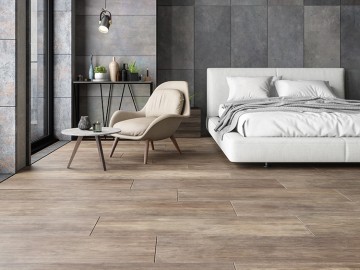
Tiles that look like natural stone or parquet? Nothing new about that. Tiles change according to the latest trends, just like any other material. Unusual designs and formats are extremely popular right now.
Whether the tiles you’re installing look like natural stone or wood, or whether they’re hexagonal, extra large or come in striking 3D patterns – as tile variety increases, so do the demands on the adhesives used. Polymer modification meets the requirements of a wide variety of shapes and structures. At the same time, polymer-modified tile adhesives can help customers implement new design ideas while saving money, energy and resources.
Click below to read why tile adhesives modified with VINNAPAS® are the ideal formula for trend-conscious consumers.
The formula that goes beyond the standards
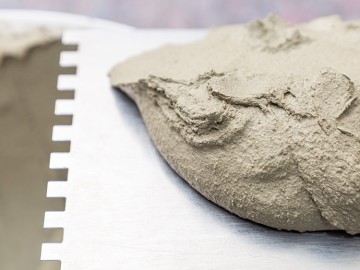
A tile adhesive has to be perfectly matched to the tiles used, the substrate and the environmental conditions. Yet how do you select the right adhesive? Standards are a place to start – but sometimes even they aren’t enough.
Starting in 1995, European Standard EN 12004 has served as the global reference for classifying tile adhesives, grouping them into two major classes depending on their adhesion: C1 for those with normal adhesive strength and C2 for improved, stronger adhesives. Both C1 and C2 tile adhesives can then be further broken down in S1 and S2 classes to indicate their flexibility: S1 is a flexible adhesive, whereas S2 is highly flexible.
These standards don’t tell us everything we need to know, however: modern tiles are often starkly different from those specified in the standard. Demanding tiles can push even a flexible C2S1 adhesive to its limits. The only way to ensure that the bond will last a long time is to increase the polymer content.
Learn what makes tile adhesives modified with VINNAPAS® dispersible polymer powders the formula that meets – and sometimes even exceeds – standards.
The formula that tilers rely on
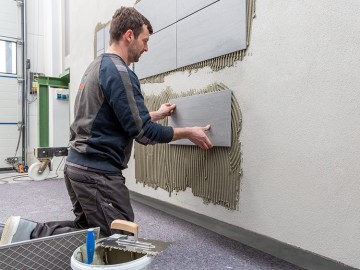
Creamy consistency, easy to apply with a trowel, greater sag resistance: these criteria are just as important to tilers as the adhesive strength and flexibility of a tile adhesive. We get that – and therefore offer special VINNAPAS® grades that are easy to work with.
More questions about tile adhesives?
Will tile installation ever be the same? Why are tiles falling off the wall? What’s the difference between C1 and C2 tile adhesives? You can find answers to these and other tile adhesive questions in our FAQs.
Professional tilers place particular importance on tile adhesives that are easy to mix and apply. That’s why our colleagues at the Tile Adhesives Competence Center in Burghausen have been working to develop VINNAPAS® grades that are even easier to work with: the two new VINNAPAS® 8819 T and VINNAPAS® 4449 T grades are all about workability.
Learn why tile adhesives with VINNAPAS® 8819 T and VINNAPAS® 4449 T are the formula tilers rely on.
The formula for a shorter time-to-market

Whether responding to new regulations, evolving standards, or changing customer requirements, our Technical Competence Centers help you adapt quickly. Located around the world, they are equipped with state-of-the-art testing capabilities and backed by decades of formulation expertise.
The experts in our Technical Competence Centers develop, optimize, and validate tile adhesive formulations under realistic application conditions. By combining regional market know-how with internationally recognized test methods and our own in-house testing procedures, we help you accelerate product development, minimize formulation risks, and bring new or optimized solutions to market faster.
Want to learn more about tile adhesives?

Read our informative articles on special applications and on the latest issues and trends in tiles and tile adhesives!
Stay up to date!
Interested in tile adhesives? Leave your contact details here and receive news on construction topics directly in your inbox!
Related: