


Our system has noticed that you are based in , but the current country setting is . Select country

Modern tile adhesives:
Fit for the future, thanks to VINNAPAS®
How do we make tile adhesives fit for the future? What role does sustainability play in that? How do we respond to the trends of tomorrow? Join us as we take a look at the latest issues and developments in the world of tile adhesives – and at new challenges and opportunities for polymer modification with VINNAPAS®.
Today’s tiles come in an incredible variety of sizes, shapes and designs. And manufacturers’ ingenuity knows no bounds. But no matter what the future of tiles looks like, here at WACKER we are ready for anything. Our extensive experience in modifying tile adhesives with polymers means we can come up with the perfect formulation for every kind of tile.
In this article, you’ll learn how VINNAPAS® dispersible polymer powders help make today’s tile adhesives fit for the challenges of tomorrow.
Fit for new materials
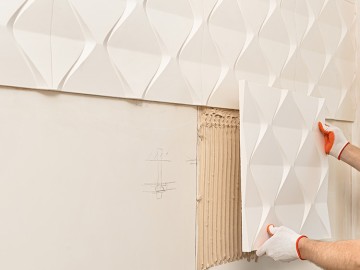
Today’s tile designers are constantly experimenting with newer and newer materials: porcelain, glass, metal, plastic – the sky’s the limit. Unfortunately, what warms the heart of interior designers is often a major headache for tile installers.

In many instances, securely bonding modern tiles to a wall or floor is more than traditional tile adhesives can handle. That’s because they were originally developed for porous materials like clay or terracotta and don’t adhere to the smooth, non-porous surfaces of porcelain or glass tiles. Plus, more and more facade tiles are installed on external thermal insulation composite systems, which complicates matters even further.

Whether in antiquity, the Middle Ages or the 21st century, tiles have always had a critical impact on the history of architecture and construction – and they’ve shaped the construction industry too. After all, new developments in tiles have gone hand in hand with new bonding techniques. Join us on a journey through the history of tiles and see for yourself!
This is where modern chemistry comes to the rescue: polymer modification with VINNAPAS® improves the properties of tile adhesives to the point where nothing will stand in the way of future material and design ideas.
Learn how today’s trends and developments in the materials industry impact tile adhesives.
Fit for new grades of cement

Times are changing for the cement industry: under pressure to reduce CO2 emissions, producers are moving away from traditional Portland cement (CEM I) and transitioning to cement grades containing less clinker (CEM II – CEM V). That poses new challenges for tile adhesive manufacturers.
Changing times for cement

You may also read our interview with Global Segment Manager Gustavo Soares, who discusses the transition in the cement industry and what that means for tile adhesives manufacturers.
Clinker production accounts for the lion’s share of the CO2 emissions generated in cement manufacturing. As a result, companies are increasingly looking to reduce clinker consumption, replacing Portland cement (CEM I) – up to now the number one choice for tile adhesive formulations – with CEM II cements. Unfortunately, doing so has a negative impact on the early strength and tensile adhesive strength of the tile adhesive.
The solution? Modifying adhesive formulations with the right VINNAPAS®grades keep important tile adhesive properties intact.
Learn how VINNAPAS® dispersible polymer powders are building bridges for an industry in transition.
Fit for sustainable sand alternatives

There’s a lot going on right now, and not just in terms of cement – sand is another major issue. That’s because, while sand is an important raw material for the tile adhesives industry, it also plays a crucial role in our ecosystems. It’s high time, in other words, that we look at sand – in granular detail!
Sand has become a scarce commodity all over the world. But tile adhesive formulations without sand? Is that even a thing? Sort of. Three teams from our mortar laboratories have launched a search for alternatives that include ground recycled concrete, artificial sand (M-sand) and desert sand. To make a long story short, sand can indeed be replaced – but that requires careful modification using suitable VINNAPAS® grades to compensate for the downsides of the substitutes.
Learn more about sustainable sand alternatives and how the use of VINNAPAS® can make them suitable for cutting-edge tile adhesive formulations.
Fit for innovative formats

Tiles that measure 150 x 300 cm? You don’t see them too often, but they’re certainly feasible. Tile sizes have been increasing for years – and there’s still plenty of room for them to grow. The larger the tile, however, the greater the challenges for installers and materials.
For XXL tiles, experienced tilers recommend using adhesives with an EN rating of C2TES1 or C2TES2. Thanks to polymer modification, these adhesives exhibit exceptional tensile adhesion strength, flexibility, slip resistance and an extended open time.
Learn about the key issues with XXL tiles and watch our video to see how to install a 1.20 x 2.60 m tile.
Fit for sustainable building

VINNAPAS® eco is a version of VINNAPAS® dispersible polymer powder manufactured with renewable raw materials rather than fossil-based resources, making it an effective tool for reducing the environmental footprint of tile adhesives.
The secret lies in the mass balance approach, a method that allows us to reduce our use of fossil resources without compromising product quality or properties. The VINNAPAS® eco grades that we produce in this way are chemically identical to their VINNAPAS® counterparts, making it easy for our customers to make the switch.
Watch our video to learn more about the mass balance approach and about how VINNAPAS® eco can help you reduce your use of fossil resources.
Fit for new market demands

Whatever future developments may bring, our Technical Competence Centers help you stay ahead of evolving market demands by developing and testing new formulations.
Equipped with state-of-the-art testing capabilities, our Technical Competence Centers combine deep regional expertise with decades of experience. By applying both internationally recognized test standards and proprietary in-house test methods, we deliver reliable solutions for today's and tomorrow's markets.
Want to learn more about tile adhesive formulations and applications?

Read our article on the basics of polymer modification and on specialty applications for tile adhesives.
Stay up to date!
Interested in tile adhesives? Leave your contact details here and receive news on construction topics directly in your inbox!
Related: