

Our system has noticed that you are based in , but the current country setting is . Select country

Luxury vinyl tile flooring – tough all the way, thanks to VINNAPAS®
Luxury vinyl tile (LVT) flooring has become increasingly popular in recent years. That’s no big surprise, considering that, in terms of look and feel, you can hardly tell the difference between LVT and wood, natural stone, or conventional tiles. Moreover, LVT flooring costs less, is less susceptible to damage and easier to maintain in contrast to its natural-material counterparts. With the right adhesive, it is in fact just as durable. So what does it all come down to?
What is LVT?
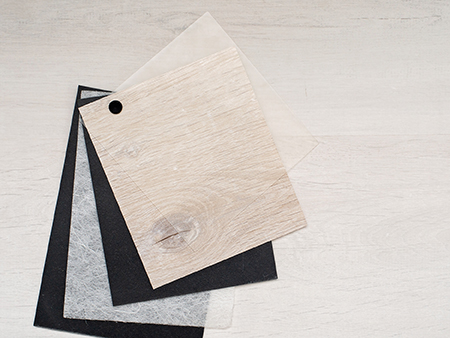
LVT (luxury vinyl tiles) refers to several different, resilient flooring surfaces made from multiple layers of synthetic materials (usually PVC). A common method used in manufacturing involves the application of a photographic reproduction of natural materials – such as wood or natural stone – to the surface using printing or embossing techniques. This process also allows manufacturers to enhance the tactile feel and achieve authentic textures that mimic the natural structure of wood and stone. Despite a wide range of tones and color schemes being available on the market, plain LVT flooring is also quite popular. The shapes and designs range from square tiles to planks of various sizes.
Wherever you may be – in a residential or commercial complex, in a mall, or even a kindergarten – all you need to do is look around, and it becomes quite evident: luxury vinyl tile flooring is fast becoming a regular feature in many areas. And for good reason too. Easy to maintain and durable, luxury vinyl is an attractive and inexpensive alternative to costly natural materials. It reduces footfall noise, is relatively easy to install, and, where necessary, repairs can be carried out on specific isolated areas.
The greater the load, the greater the demands on the adhesive
By virtue of its durability, LVT flooring is also suitable for areas subject to a high degree of wear and tear, for example hospitals, kindergartens, or public areas with heavy foot traffic. What applies to every type of flooring: the greater the load, the greater the demands on the quality and performance of the adhesive used.
Thus, as is the case with all types of flexible flooring, LVT flooring too requires special adhesives formulated from a variety of ingredients. In this context, the binder plays a particularly important role. Owing to their specific performance characteristics, our VINNAPAS® vinyl acetate-ethylene (VAE) polymer dispersions are ideal for formulating adhesives for flexible flor coverings.

Advantages of VINNAPAS® VAE polymer dispersions for flooring adhesives
Adhesion, cohesion, tack – are they the same or different?


Key factor: A perfectly smooth substrate
For maximum reliability and durability of LVT floor coverings, a uniformly smooth substrate is essential. This can be achieved efficiently using self-leveling compounds (SLC).
Our VINNAPAS® dispersible polymer powders of class L and F enable the formulation of low-emission SLCs that are safe, consistent, and easy to apply. Self-leveling compounds formulated with VINNAPAS® produce smooth, pore-free surfaces, creating the ideal foundation for high-quality LVT flooring.
Further information on the role of VINNAPAS® in self-leveling compounds can be found here.
Flooring adhesives put to the test

Adhesives for floor coverings are generally made up of binders (e.g., VINNAPAS®), tackifiers, fillers, thickeners, and other ingredients. At our technical competence centers, we rigorously test various formulations for their properties. Flexible PVC strips glued to fiber-cement boards serve as test samples. A notched trowel is used to apply the flooring adhesive.

Setting time and open time
The test samples are peeled off at specified intervals using a spring balance. The setting time refers to the period of time during which an adhesive transitions from a liquid to a solid state. It determines how quickly the floor covering bonds to the substrate without, for example, curling upward. A long open time makes installation easier: the adhesive can be applied to the entire surface immediately.
Formulations with VINNAPAS® have a shorter setting time and a longer open time.

Heat resistance
In the heat resistance test, the test samples are initially stored for seven days. Thereafter, they are loaded with a static weight of 0.5 kg and a peel angle of 90° and stored at 60°C.
Formulations with VINNAPAS® display greater heat resistance.

Peel strength
Peel strength refers to the force required to separate two materials by pulling one of them at a specific angle. We conduct the test in different temperature ranges and over different time periods.
Formulations with VINNAPAS® exhibit greater peel strength.
Interested in learning more about our solutions for building and construction adhesive applications?
Related: