
Our system has noticed that you are based in , but the current country setting is . Select country

EV battery thermal management/thermal runaway containment:
Test results for silicone-resin-based heat shields
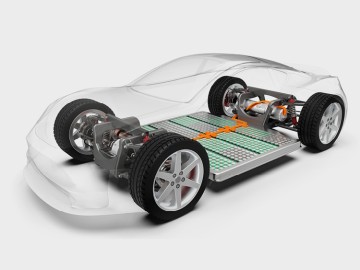
When lithium-ion batteries in electric vehicles fail, every second counts: silicone resins from WACKER help protect the vehicle’s passengers. Silicone resins set new standards that push battery safety to a higher level, and can also be used for mica-free heat shields.
Why use silicone resins for battery heat shields?
Two ways to contain thermal runaway in batteries

Dr. Vera Seitz is an expert in battery heat shields made from silicone-resin-based fiber composites.
All is quiet in her office. The only sound is the hum of the fans as Dr. Vera Seitz checks the results of the latest thermal propagation test.
Despite a deliberately triggered thermal runway: no flame breakthrough, no damage to the panel – instead, excellent thermal insulation. The rear-surface temperature of the tested silicone resin laminate remains below 140 °C.
In contrast, the venting jet striking the tested panel directly above the ignited battery cell reaches temperatures of up to 1,150 °C, while temperatures in the indirect venting path areas peak at over 1,000 °C. And yet, the silicone-resin-based glass fiber composite panel remains intact.
Dr. Seitz, an expert in EV battery shields made from silicone-resin-based fiber composites, explains why:
"We have two effects in play here:
Test-driven development
Every component must be built to withstand an emergency. That’s why the team focuses on intensive thermal propagation tests with the latest cell types.
Dr. Daniel Becher, an expert in battery safety testing at PROTEBA, puts it like this:
"We design the tests so that the post-mortem analysis reveals which solutions are effective. We work with WACKER to evaluate cell reactions and temperature curves. In general, if a result can be reproduced at least three times in these tests, the approach can be considered reliable."
For Dr. Vera Seitz, too, it is never about running a single test. And that is precisely what makes electromobility safe: testing, testing, testing.
She clicks on "Save report" for the day. Her gaze lingers on the screen for a moment. She leans back. Out there, millions of electric cars are on the road. And in here is where the safety is created that protects lives and advances electromobility.
Test results: Thermal propagation test
Protection in the event of thermal runaway
The silicone resin/glass fiber composite protects the battery cover from venting damage and electrocoat combustion. How it protects passengers: it increases the time available for passengers to exit the vehicle safely.
Applications: Protection against venting damage and electrocoat combustion
Temperatures

Post mortem: front surface

Post mortem: rear surface

Download: Thermal propagation test results
Results of the test on round cells in 46xxx format
(NMC, very high nickel content, approx. 35 Ah capacity)

Test results: Thermal propagation containment
Video: Thermal propagation test
FAQs
What is a thermal propagation test and how does it work?
A thermal propagation test (also known as a "thermal runaway propagation test") is a central component of battery safety testing in the automotive sector. The aim is to investigate how a thermal runaway of a single cell affects adjacent cells. The test evaluates whether and how the heat and the reaction spread.
It typically involves the following steps:
When is a thermal propagation test considered passed?
The test is generally considered passed if the heat shield remains intact and no breakthrough of flame or hot particles is observed.
The heat shield must also have a good insulating effect. In other words, during the test, the rear-surface temperature of the test panel must remain as low as possible, for example < 200 °C.
How was the thermal propagation test for the heat shield set up?
A high-capacity, realistic system was tested:
The silicone resin/glass fiber laminate was installed above the cells to act as a heat shield. In the event of a thermal runaway, this heat shield effectively prevents particles and flames in particular from escaping to the outside. It is therefore often used in the area of venting channels or to protect battery or module covers. The adjacent cells were protected with appropriate potting materials.
Test setup of the battery module

Structure of the battery cover

Heat shield in the test

Finished battery test module

Which composite was tested as the heat shield for EV batteries?
A silicone resin/glass fiber composite. The panel was made this way:
Which properties leads to a very good result in the thermal propagation test?
Silicone resins offer exceptionally high flame and heat resistance. They are characterized by a low fire load and compatibility with fillers and fibers. When exposed to fire, they undergo ceramification, forming a protective layer.
The functional integrity of a silicone-resin-based laminate therefore remains intact throughout the fire event.
Consequently, these fiber composites are suitable for, e.g. heat shields. They provide targeted protection for the passenger cabin during a thermal runaway.
Products suitable for silicone resin composites in the area of fire protection/battery safety:
What is the function of the fiber structure and silicone resin combination?
Glass, carbon or mineral fibers possess high heat resistance. However, depending on the textile construction, they remain permeable to flames and escaping particles during a thermal runaway.
Furthermore, because pure fiber materials are inherently flexible, individual filaments can be displaced under stress. Overall, their mechanical resistance is often insufficient to withstand the high-pressure impingement of the vented particles.
The combination of a silicone resin binder with a heat-resistant reinforcing fiber creates a rugged composite panel. This acts as a shield against both flames and particles expelled from the cell under high pressure for extended durations.
Are the results of the thermal propagation test transferable?
Absolutely. We tested standard laminates from our laboratory. Manufacturers of fiber composites may utilize their expertise to select other fibers or optimize the layer structure. This allows them to tailor and enhance the laminate’s performance even further. However, tests will still be needed on the final material.
How is the composite material for heat shields made?
Silicone-resin-based composites are made from prepregs in a two-stage process. First, silicone resin prepregs are produced from the desired fiber material. Then, the prepregs are hardened at elevated temperatures under pressure. However, alternative, standard manufacturing processes in the fiber composites industry are generally feasible as well.
What are the specific steps in the production of a silicone resin prepreg?
Currently, the prepregs are made from solid silicone resins (such as SILRES®MK) in solvent-borne processes. Alternatively, resin solutions such as SILRES® K may be employed.
Impregnation

The fiber materials are pre-impregnated with a catalyzed silicone resin solution.
Drying

The impregnated fibers undergo a drying stage at 100 – 150 °C (depending on the solvent).
How are silicone resin prepregs processed into the finished composite material? Are complex component geometries also possible?
The silicone resin and fiber prepregs are made into three-dimensional molded parts under high temperatures and pressures. This enables large-area heat shields to be manufactured in automated processes.
Three-dimensional molded parts obtained by hot pressing
Preparation

The prepreg is cut and stacked.
Hot pressing/3D shaping

The prepregs are pressed to form three-dimensional molded parts at 160 – 200 °C
Postcuring

The laminate can also be postcured. (e.g., at 200 °C)
Are near-net-shape geometries possible?

Three-dimensional component made of silicone-resin-bonded glass fiber laminate (left) and carbon fiber laminate (right)
Near-net-shape geometries (with shoulders, grooves, etc.) matching the overall battery design are also possible.
The thickness of the heat shield varies from < 1 mm to usually 2 mm, depending on customer requirements, fiber material and layer structure. Reworking in the form of milling or punching is also possible.
Can I buy a heat shield for electric vehicle batteries from WACKER?

No, we do not supply finished composite materials – instead, we supply silicone resins as binders.
We have tested our silicone resins intensively with the following materials:
Our technical experts will gladly advise you on how to formulate your recipe.
We would be happy to refer you to our partners. These will provide assistance on how to process silicone resins into prepregs or finished heat shields.
How can we help move your project forward?

Christoph Popp, Global Segment Manager for E-Mobility
We are a leading silicones manufacturer with four excellence centers focused on e-mobility issues. Our global teams support OEMs and first-tier suppliers, from the initial concept to series production.
Drop us a line!
Related: