
Our system has noticed that you are based in , but the current country setting is . Select country

Sustainability is feasible: facades
First impressions count – and that goes for buildings too. But it is not only the facade that determines whether a building appeals to us aesthetically. In many cases, its appeal hinges on how sustainable it is too. Because facades offer fantastic opportunities to put sustainable construction into effect.
Whether in mortar, paint or a tile adhesive, our construction chemicals often make up only a tiny proportion of the material. Nevertheless, they make a big difference: they give products their special properties in terms of performance and durability. And last but not least, they make a crucial contribution to sustainability. Facades offer us five levers to achieve this – see for yourself
Lever #1:
Increasing energy efficiency

In the European Union, 40% of energy consumption and 36% of greenhouse gas emissions are caused by buildings.1 Most of them are caused by heating and cooling. Forming part of thermal insulation systems and water repellents, our polymers and silicones can help to reduce energy consumption and harmful emissions considerably.

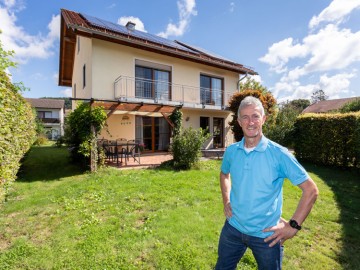
In a typical single-family house in Germany, 40% of the heat is lost through the external walls. Efficient thermal insulation can help here.
Thermal insulation makes the difference
A building loses a lot of heat through its facade. Efficient thermal insulation can help here, as it can save up to 70% of heating energy. External thermal insulation composite systems (ETICS), which are applied to the outside of the facade, are a time-tested solution here: they reduce energy consumption in both cold and hot climates and significantly increase the energy efficiency of buildings. Our VINNAPAS® dispersible polymer powders and dispersions play a major role in ensuring that ETICS functions properly: these polymeric binders not only strengthen the adhesive bond between the insulation panels and the various substrates but also boost the flexibility and impact strength of the entire system.
Results at a glance
Our study in Dubai involves two model houses that are identical apart from the fact that one of them has ETICS installed. The energy consumption and CO2 emissions of this house fall by 60% in each case.

A good alternative: thermal insulation render (TIR)
Thermal insulation render (TIR) is another option for insulating external walls. TIR’s low thermal conductivity significantly contributes to energy savings for heating and cooling while making living conditions more comfortable. Polymer modification by means of VINNAPAS® optimizes the properties of thermal insulation render: improved adhesion and compressive strength, better workability and greater flexibility, hydrophobicity and water-vapor permeability.

Facade impregnation reduces energy consumption
Not only a lack of thermal insulation, but also damp facades and insulation materials have a negative effect on a building’s energy balance. Even a moisture content of 4% leads to an energy loss of as much as 50%. This is where a hydrophobic impregnation with SILRES® BS helps: it reduces the capillary water absorption of construction and insulation materials by 80% without restricting water-vapor permeability. The result is permanently dry walls, an improved energy balance and a healthy indoor climate.
Lever #2:
Reducing renovation cycles

Renovation costs time, money and nerves. Above all, however, it consumes resources and generates additional emissions due to the transport routes involved. The answer? Renovate less! Our additives and binders optimize plasters/renders and exterior paints so that they last longer, are less susceptible to cracking and dirt pickup, and protect facades against moisture. In this way, they can help to extend maintenance intervals.
Modified plasters/renders last longer
WACKER supplies binders and additives for a number of plaster types, such as those based on cement or silicone resin as well as ready-to-use dispersion-bound types. Our products improve important properties such as processability, adhesion, flexibility, mechanical resistance, hydrophobicity and weatherization. In this way, they contribute to the durability of facades.

One example is the modification of mineral plasters by means of VINNAPAS® polymer binders. These ensure that plasters adhere permanently even to critical substrates that are difficult to coat. At the same time, the plaster becomes more flexible and can absorb stresses caused by substrate movements or temperature fluctuations. The plaster does not crack and its mechanical strength increases to the extent that it will not spall even when, for example, something hits it. What is more, specialty VINNAPAS® grades give plasters hydrophobic properties: they reduce capillary water absorption without impairing the water-vapor permeability of the system.
The network holds the key
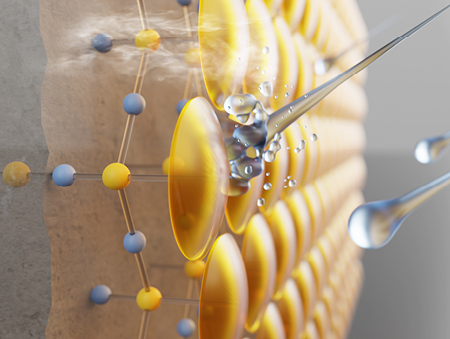
Silicone resins protect mineral surfaces against water, without impairing their water-vapor permeability – and they do this reliably and permanently. The silicone resin forms a UV-stable and water-repellent network within the paint. The paint is permanently protected against water ingress, but is still able to breathe because water vapor can continue to pass through it. So, on the outside, the brickwork is protected against moisture and, on the inside, natural water vapor is able to escape unhindered.
Silicone resin emulsion paints (SREP®): an economical solution
Our SILRES® BS silicone resins work wonders in facade paints. Silicone resin emulsion paints (SREP®) combine the outstanding properties of mineral and synthetic-resin-bound coatings: very high water-vapor permeability and extremely low water absorption. They are also highly UV-resistant and have low dirt pickup. An important parameter in this context is the low tackiness of silicone resin emulsion paints: it causes dirt and dust particles to adhere less – with the result that facades look clean for a long time. On average, the use of silicone resin emulsion paints makes every other facade renovation unnecessary – therefore saving a considerable amount of resources and CO2.

Protection against unwanted graffiti
Every year, unwanted graffiti causes millions of euros’ worth of damage in Germany alone. Homeowners who discover a “piece” or “tag” on their facade have no choice but to get it removed or painted over at considerable expense. Preventive treatment of the facade by means of an anti-graffiti coating based on silicone (SILRES® BS 710) is one way to solve the problem: simply sprayed onto concrete, brick or plaster/render or applied with a roller or brush, it forms a permanent protective layer from which graffiti can be washed off with cold water and without additional cleaning agents. The coating resists heat, frost, UV radiation and moisture and offers permanent protection. This technology is free of tin-containing catalysts and oxime crosslinkers.

Protection of unique street art
Facades are not the only surface you may want to protect from graffiti. Sometimes you want to protect the street art itself. A good example of this is the METAMORPHOSIS art project in a pedestrian and cyclist underpass at Munich East Station, very close to our new headquarters building.
A local collective known as “Die Städtischen” (The Urbanites) transformed the dreary tunnel into a public art space – and a pleasant place to pass through. The colorful design is permanently protected by a layer of SILRES® BS 710
Lever #3:
Preservation, not demolition

Whether old buildings are valuable financially or historically, there are many reasons to preserve them. In most cases, furthermore, restoration of a building makes more ecological sense than demolishing and rebuilding it. Our solutions help to preserve buildings for generations. Protection against moisture is vital in this regard.

Capillary water absorption: water is absorbed by an untreated surface but forms a bead on the impregnated one.
Preventive dampproofing means facades keep their fresh look
Facades are exposed to wind and weather around the clock. If water and moisture penetrate into concrete or masonry unchecked, the result might be serious damage. Our SILRES® BS range features highly effective products for the preventive protection of mineral building materials against the penetration of moisture.
The SILRES® BS portfolio includes water- and solvent-based grades, microemulsion concentrates and SILRES® BS CREME for drip-free application, even when you work overhead. These products can be used to impregnate concrete, natural stone, limestone, bricks, aerated concrete (AAC) and sand-lime brick. SILRES® BS penetrates deep into the pores of the substrate and prevents capillary water absorption without affecting breathability. Facades that have already been coated with mineral plasters or paints can be given added water-repellent protection too.
References with SILRES® BS


How a horizontal barrier with SILRES® BS works - the masonry above the horizontal chemical damp-proofing barrier (yellow) remains dry, even when moisture pushes up from below. In chemical damp-proofing, the active ingredient reacts with the building material’s silicate matrix to reduce the surface tension. This puts a stop to capillary water transport and the masonry dries out permanently.
Subsequent dampproofing
Once water gets into a wall, the only thing that helps is to drain it by using a horizontal damp course that stops rising damp. The best results are achieved with a chemical dampproof course, which involves injecting a liquid into the masonry. This is where our solvent-free, silane-based/siloxane-based SILRES® BS microemulsion concentrates come into play: they are simply diluted with water and injected into the drill holes under pressure.
An alternative for gravity injection is our ready-to-use SILRES® BS Creme D. All products form an effective horizontal damp course even in the case of high moisture penetration – with several positive effects: valuable building fabric is preserved, and the insulation capacity is retained, which saves heating energy.
Lever #4:
Saving on materials

Less is more – this applies to the construction industry as well. After all, less building material not only means savings in terms of primary energy and resources. It also means less transportation and therefore fewer CO2 emissions. Construction materials that provide greater efficiency play a key role here. We can offer various solutions in this regard.

Better tile adhesives, less consumption
Tiled facades are becoming more and more popular. Tiles protect the facade and create a unique aesthetic. Our VINNAPAS® dispersible polymer powders improve the technical properties of tile adhesives, make the adhesives more durable and enable even the most demanding of tiles to be bonded to the facade reliably and durably. They also make it possible to switch from the thick-bed to the thin-bed method. This improves the carbon footprint of the entire system: less mortar is needed during construction, which means less transportation and fewer resources, especially sand. Less rubble is produced during demolition. As a result, a thin-bed tile adhesive, from when it is made until it is disposed of, produces as much as 60% fewer greenhouse gas emissions than a thick-bed tile adhesive mixed on site.
Results at a glance
The carbon footprint calculation is based on ISO 14040/44. A VINNAPAS® vinyl acetate-ethylene (VAE) binder was used in a C2 mortar according to EN 12004. The outcome may vary due to local conditions. Here, a European setting was assumed. When the fossil-based VINNAPAS® vinyl acetate-ethylene (VAE) grade is replaced by a bio-based VINNAPAS® eco grade, CO2 emissions are further reduced.


Optimized powder paints
Powder paints score points for their elegant, matte hue and their durability. What’s more, they are made without the addition of solvents or plasticizers. VINNAPAS® polymer powders enhance the durability of powder paints and reduce water uptake. They also optimize the opacity, adhesion and efficacy of powder paints, thereby ensuring that less paint is needed.
Lever #5:
More sustainable products

Our construction chemicals help to make facades more sustainable. These chemicals themselves have become ever more sustainable in recent years. Our target is for 100% of our products to meet sustainability criteria by 2030. And we’re making good progress.

WACKER eco products are certified in line with the REDcert2 standard, based on the mass balance approach. This certification confirms the replacement of fossil raw materials by renewable ones and is verified by a recognized and independent testing body.
WACKER eco products: time-tested quality with renewable raw materials
We now supply many of our VINNAPAS® brand polymer binders as eco grades. They do not differ from conventional grades in terms of formulation and quality, but they do differ in terms of production. The mass balance approach means that fossil raw materials are replaced by renewable ones. This approach meets the criteria of the REDcert2 standard for tracing renewable raw materials and is audited by third parties.
VINNAPAS® eco polymer dispersions, dispersible polymer powders and solid resins are used, for example, in external thermal insulation composite systems, facade paints and plasters/renders.
Sustainability to order
To make a mass balance product, we feed renewable raw material into the production process instead of the fossil variant. The organic substance is subsequently allocated to the mass balance product that the customer has ordered. This is purely a mathematical process: the amount of renewable raw material used is allocated to the mass balance products – mathematically speaking, all of the remaining products are therefore based on fossil feedstocks (see illustration).


Get news on construction topics directly in your inbox!
Leave your contact details here and be the first to be notified about trends and news relevant to the construction industry.
Related: