
Our system has noticed that you are based in , but the current country setting is . Select country

Inside the lab:
Testing tile adhesives worldwide
Tile adhesives are used all over the world. Yet the conditions under which they are applied differ greatly: tiles, climate, substrates and raw materials vary from region to region. Ensuring reliable performance under all circumstances therefore requires thorough testing. This is what our experts at the WACKER Technical Competence Centers do on a daily basis. Let’s take a look inside their laboratories in Burghausen, Germany.
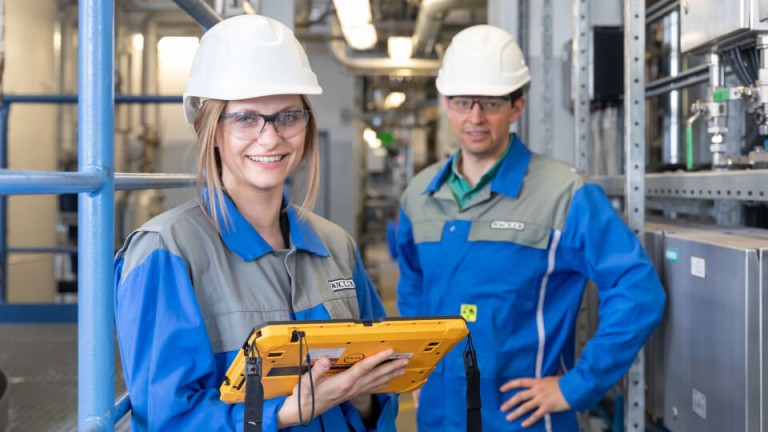
Around the world, our Technical Competence Centers support customers in developing and optimizing tile adhesive formulations for a wide range of applications. Our experts are familiar with regional requirements and the conditions that drive adhesive performance.
Their work combines internationally recognized standards with decades of application experience, including the development of supplementary WACKER in-house testing methods. The result: formulations that perform reliably under real-life conditions.
Whatever your next tile adhesive project may be, our colleagues at the Technical Competence Centers will be happy to support you.
Talk to our experts!

Dr. Klas Sorger, Head of Global Technical Competence Center for Tile Adhesives and Grouts
You want to know more about our testing methods or see the tests in action? Our colleagues at the Technical Competence Centers worldwide are happy to share their expertise and help you find the right tile adhesive formulation for your success. Get in touch to discuss your specific requirements.
Testing tile adhesives inside out
The following videos give a brief look inside the Technical Competence Center Burghausen and introduce key testing methods that help evaluate the performance and workability of tile adhesives. For more details on the testing methods or to see the full tests in action, get in touch!
Tensile adhesive strength
Tensile adhesive strength is one of the most important properties of a tile adhesive. It determines whether a formulation is suitable for:
We assess tensile adhesive strength in line with the European standard EN 12004 and can adapt our testing methods to other standards on request. Formulations modified with VINNAPAS® dispersible polymer powders reliably achieve Class C2.
Flexural and compressive strength
Tile adhesives have to withstand a variety of mechanical stresses – from the weight of the tile to the bending and shear forces caused by temperature changes or substrate movement.
Adding suitable binders such as VINNAPAS® dispersible polymer powders can significantly improve both flexural and compressive strength of tile adhesives.
Deformation/flexibility
Flexibility is a critical property of tile adhesives, as tiles and substrates undergo temperature changes, moisture, shrinkage and mechanical loads. For large-format tiles in particular, a flexible adhesive absorbs movement instead of transferring stress to the tile layer – reducing the risk of cracking and delamination.
EN 12004 classifies deformability as S1 or S2. Polymer modification with VINNAPAS® dispersible polymer powders enables formulations that meet both classes for demanding applications.
Slip resistance
The slip test determines the slip resistance of a tile adhesive – that is, its ability to stabilize the position of tiles on vertical surfaces and prevent them from sinking into fresh mortar.
Dispersible polymer powders such as VINNAPAS® help achieve the right balance between workability and dimensional stability – tiles stay where they are placed, and the adhesive remains easy to apply.
Open time
Open time is the maximum time interval after application within which tiles can be embedded into the adhesive while still achieving the specified tensile adhesion strength. If it is too short, the surface skins before tiles are placed, leading to poor adhesion and later tile failure.
Sufficient open time is especially important when:
Open time should not be confused with correction time, which is the period after placement during which tiles can still be moved without losing adhesion.
Polymer modification with VINNAPAS® dispersible polymer powders improves wetting behavior and helps ensure reliable adhesion even when tiles are placed later in the process.
Discover VINNAPAS® dispersible polymer powders for tile adhesives
Explore our portfolio of VINNAPAS® dispersible polymer powders designed to enhance the performance and workability of your tile adhesives.
FAQs about tile adhesive testing methods
Why and how are tile adhesives tested?
Tile adhesives are tested to verify performance under defined, comparable conditions. Internationally recognized standards such as EN 12004 cover key properties including adhesive strength, flexibility, slip resistance, open time and mechanical strength.
Is special laboratory equipment required for testing tile adhesives?
Yes. Standards prescribe specific equipment and controlled environmental conditions for preparing, conditioning and testing specimens – including heat and freeze-thaw chambers. Reliable results depend on having the right infrastructure in place.
Are the WACKER Technical Competence Centers equipped to test tile adhesives?
Yes. We have been working with tile adhesives for decades. In Burghausen, Germany, we operate a Technical Competence Center dedicated to cementitious mortars, and we run additional Technical Competence Centers for polymers around the world.
What else do the WACKER Technical Competence Centers do?
Our Technical Competence Centers support customers in developing and optimizing dry-mix mortar formulations such as tile adhesives. Located in key regions worldwide, they combine application expertise with knowledge of local raw materials, building practices and climate conditions.
What properties are most important for tile adhesives?
Adhesive strength, flexibility, workability, slip resistance and open time. Together, they determine whether tiles bond reliably, accommodate movement, and can be installed efficiently and securely.
How do polymer binders improve tile adhesive performance?
Polymer binders improve adhesion, flexibility and workability. Dispersible polymer powders such as VINNAPAS® help cement-based adhesives bond more strongly to tiles and substrates, and allow the adhesive layer to accommodate movement without cracking or losing adhesion.
Stay up to date!
Interested in tile adhesives? Leave your contact details here and receive news on construction topics directly in your inbox!
Related: