
Our system has noticed that you are based in , but the current country setting is . Select country

Hydrogen: building the foundation for the future today
Hydrogen is already a key molecule in today's chemicals industry. However, its production relies on fossil sources and involves high emissions of CO2. Green hydrogen is therefore critical for a climate-neutral chemicals industry. High costs and a lack of infrastructure are still holding back widespread adoption. Nevertheless, we are already preparing for a future where green hydrogen serves as a raw material and replaces fossil energy carriers.
Small, light, inconspicuous: hydrogen is the first element in the periodic table and, at the same time, an important building block of industrial transformation. This colorless, odorless gas can store energy and drive chemical reactions. It already plays an important role as a raw material in the chemicals industry, but its manufacture is extremely CO2-intensive: 100 million metric tons of hydrogen are produced each year, and 10 to 12 metric tons of CO2 are released per metric ton, with 60% of that coming from the chemicals industry. That is why we are already preparing today for a world in which “green” hydrogen will play a major role in the defossilization of chemical processes and products.
Prerequisites for a hydrogen network
Manufacturing green hydrogen requires a great deal of renewable energy. In the future, a large part of it will be produced in places where large quantities of renewable electricity can be generated cheaply – in regions with abundant wind or solar resources, whether in Europe or elsewhere. High-performance transport networks are needed to ensure that hydrogen reaches Europe's industrial centers.

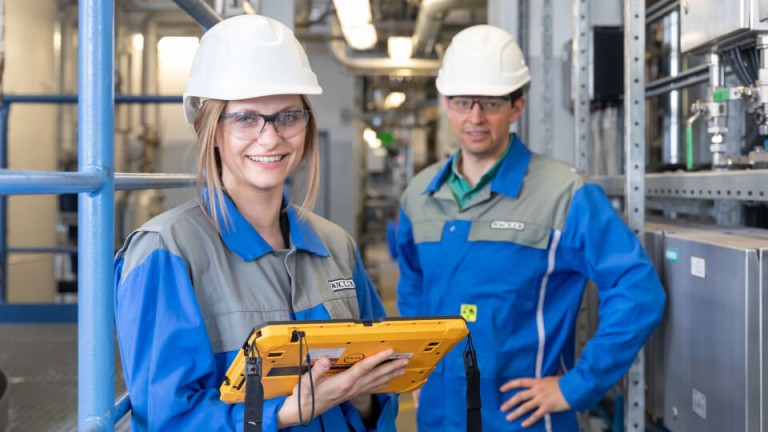
We are preparing our plant in Burghausen for green hydrogen. It could play an important role in production and help reduce emissions.
A particular spotlight is on our production plant in Burghausen, Bavaria. We are working with partners to secure timely access to network connections and capacity, to further develop technical concepts, and to open up future sources of supply. This also involves preliminary agreements with energy providers. We are also supporting the Bavarian Hydrogen Import Alliance (HIBB), which is working to connect the Bavarian Chemical Triangle to international sources of hydrogen.
Expensive today, but a competitive advantage tomorrow

Pipelines and infrastructure are prerequisites for ramping up the hydrogen economy. They are necessary for transporting green hydrogen
Large-scale green hydrogen projects are often not yet economically viable. Production, transportation, and infrastructure cost significantly more than petroleum gas and existing hydrogen supply systems.
However, the underlying conditions are changing. As networks expand, production capacities increase, and European interconnectivity improves, hydrogen could become substantially more important in the 2030s. In the meantime,we are using the time to create the necessary prerequisites.
Hydrogen is already indispensable to us today. When produced conventionally, it plays a central role in the manufacture of polysilicon and pyrogenic silica (HDK® ). At the same time, green hydrogen is opening up new possibilities for using carbon dioxide as a raw material. For example, CO₂ from existing processes, together with green hydrogen, could be converted into renewable methanol. The CO₂ would remain in the material loop. Methanol, in turn, is an important precursor for the manufacture of silicones.
Ready for the future

Renewable energy from wind and solar power is the basis for the manufacture of hydrogen.
Green hydrogen is an important building block on the path to a climate-neutral chemicals industry. That is why we are already investing in partnerships, infrastructure, and new areas of application. Our aim is to make greater use of hydrogen in production in the future and to gradually replace fossil-based raw materials.
This will not only strengthen the Bavarian Chemical Triangle, but also ensure the long-term viability of Europe as an industrial site.
Related:
RACE TO ZERO
WACKER has joined the UN carbon neutrality initiative “Race To Zero”. By 2030, we aim to cut our greenhouse gas emissions in half through specific projects and measures, and to operate and produce in a climate-neutral manner by 2045.